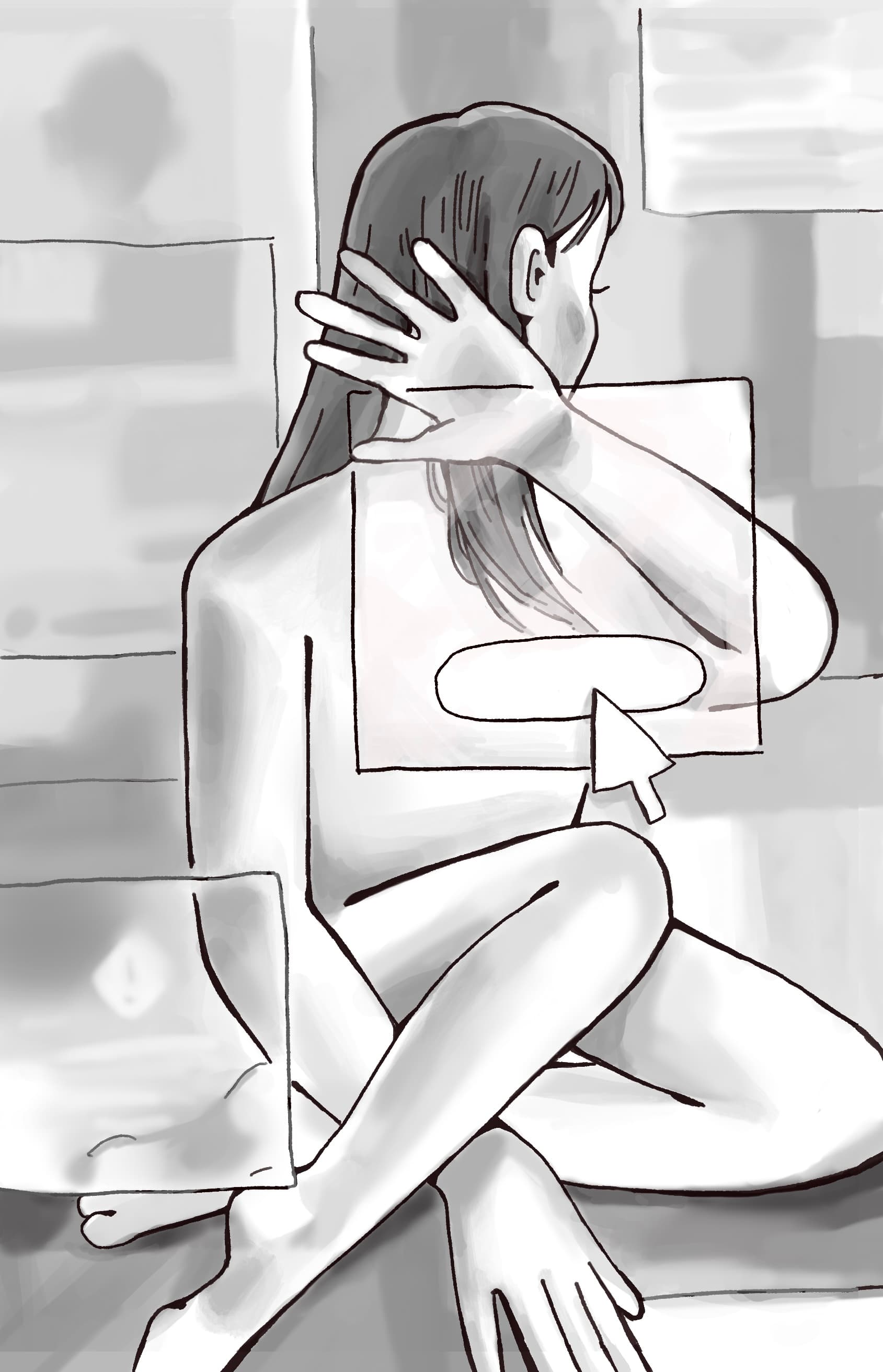
Towards the end of 2023, I became increasingly interested in the ways that explicit images operate online. I was single and living in London, a combination that lends itself to reckless decisions in pursuit of casual dating. Meanwhile, the British Government was implementing the Online Safety Bill, an Act designed to protect users, and reality TV star Stephen Bear was imprisoned for revenge porn in a landmark case.
I’d like to pretend my research was driven by professional curiosity, but largely, it resulted from my negative experiences sharing nudes online. This manifested in an obsession with trawling a variety of sites to work out where my explicit images might have ended up, and what I could do about it.
I found something predictably erotic about scrolling through subreddits like r/wouldyoufuckmywife. Behind the NSFW (Not Safe For Work) content warning, women are posed in similarly compromising positions. Some are tied to their beds, some are on their knees, some remain anonymous with only close-up photos of their vaginas, while others boldly maintain eye contact with the camera, and in turn their 860,000 voyeurs.
This subreddit operates under strict rules and could be quickly ruled out. I had never posed for photos that would comply with the verification process, hadn’t taken “at least three distinct color photographs of [myself] from different angles” containing “[my] exact Reddit username, the current date and year, a specific mention of r/wouldyoufuckmywife” and most importantly, these must all be taken nude.
AnonIB offered a more disturbing display, with photos that were recognisably amateurish. The nudes might be coyly covered by snapchat text, or bordered by a screenshot of an iPhone screen. In this trading-card-like website, men post nonconsensual nudes of women, categorised depending on location with requests like “Montgomery County is a big place with lots of sluts. Share them.” They might post a photo of an unidentified woman posing in a black dress with the caption “anyone have?” scoring a “win” if someone completes the request. Despite multiple attempts to shut down the site, including a raid, it has continued to persist, buoyed by a community of men hellbent on humiliating women.
I would follow the same pattern every time I entered the site, clicking through the sub-genres relevant to me (United Kingdom; London; University of Birmingham). My nausea would settle only once I had exhausted the newest picture uploads, my search becoming more frantic as I was driven by the knowledge that the site’s only rule — that those who do not share posts are banned — meant that my presence was finite.
After each of these sessions, I would close my tabs, feeling little relief as I knew the cycle would repeat the next day. I had set myself a sadistic sisyphean task that I couldn’t solve — I couldn’t wade through the never-ending uploads, couldn’t find every website they might be available on.
To understand my all-encompassing neuroses, I first have to introduce you to Chuck.
Chuck and I met in January 2023, first on Tinder and then in a South West London pub. He was a “soft boy”, a 24-year-old museum curator who described himself as a “golden retriever looking for a black cat girlfriend.” We bonded over our shared affinity for Shostakovich and Wes Anderson, and I invited him to mine to watch Life Aquatic with Steve Zissou.
We met up just three times across our year-long relationship (using the term “relationship” very loosely), primarily communicating across Instagram and Snapchat. I can’t recall Chuck ever explicitly broaching the subject of cuckolding, rather it was something he subtly integrated into our conversations. At first he just seemed unusually curious about my dating life: had I had sex with anyone else? Were they better than him? Were their dicks bigger?
Within cuckolding dynamics there are three vital roles: the cuckold, bull and the hot wife. Or with reversed gender roles, the cuckquean, cuckcake and hot husband respectively. The cuckold (Chuck) refers to the male partner of an adulterous wife (me), whether the infidelity is known or not. Bull refers to the dominant partner who has “taken” the hot wife, establishing a dynamic in which the cuck is passive in his own relationship, emasculated by the bull, and often, his own wife.
And yet, in performing the role of cuckold, Chuck was rarely passive, insistently asserting his masculinity and dominance through sharing my nudes without my consent with communities of men he had met across various platforms. It established a hierarchy in which I was always at the bottom, with my humiliation made two-fold at the hands of both the cuckold and the bull.
He openly fantasised about the other dates I was going on, fleshing them out with the small details I was comfortable sharing. In the texts I screenshot after we ended things to remind myself how awful he was, he writes: “it’s kinda hot imagining you getting shagged by someone terrible. Like your [sic] so sweet pretty and intelligent, and some terrible guy is using you like a fuck toy.”
For Chuck, part of the fantasy was that these terrible men would make me go running back to him, my knight in shining armour. In order to fulfil that fantasy, it meant procuring his own “terrible guys” to call me names and pressure me, comparatively making him seem understanding and kind. He talked about apps like Feeld and FetLife but never gave me the freedom to choose the men I would be interacting with — Chuck would remain the central figure carefully coordinating his exact fantasy. Thankfully for him, the internet provided no shortage of ways for him to invite other men in, and the more he pushed my boundaries, the more I felt unable to impose any rules whatsoever because I had put up with so much for so long.
The way Chuck found these men contradicted a lot of the core principles of the sites themselves. One of FetLife’s rules is that they are “not a meat market”, establishing an attitude towards sex that is primarily one of care and intimacy. This is a far cry from Chuck’s transactional approach in which people were only useful so long as they kept up the facade of his fantasy, frequently blocking those that refused to cooperate.
Despite its outdated and clunky interface, FetLife provides one of the best and safest kink forums. Profiles on the site are detailed and fleshed out (excuse the pun) as an individual’s sexuality is part of the whole well-rounded self. Despite having the online presence of a back alley club, user safety is a priority - when I created an account to find interviewees, it was almost immediately suspended.
Spaces like this can be liberating, educational and pleasurable, something user Tatyannah King has experienced first-hand. Now a sex blogger, she admits she had “ZERO experience with kink and BDSM” before visiting Exxxotica Expo, an event she attended on a whim after seeing “a huge billboard” when visiting her boyfriend in Chicago. She said in an email, “everything looked intriguing, so I asked one of the Doms to tie me up at the Shibari station.” This dom then suggested she join FetLife.
Being on the site has expanded her ideas of sex. She says, “regardless of whether you develop new kinks or fetishes or not, being exposed to different sexual behaviours can benefit your sex life because it’ll broaden your outlook on the different ways that sex can look.”
When navigating FetLife, Tatyannah says explicit boundaries are crucial. She won’t allow people to directly message her until she has met them in person, or unless it’s related to an event. When meeting people in person, she says, “I typically don’t have sex with people unless we’re already in a relationship, the emotional connection is already strong enough, or there’s a sexual fantasy that’s impossible to resist.”
In contrast, sites like Feeld have a more reductive quality. What was once designed for non-monogamy and other relationship models has become a Tinder substitute for casual hookups. From my experience, Feeld is much more unpredictable, with men frequently leading with graphic descriptions of often violent fantasies (throat fucking seemed to be a favorite.) My bio explicitly stated that I was on the site purely for an article, and yet I was regularly subjected to unsolicited dick pics. One man agreed to be interviewed on the condition that it be conducted while sitting on his face; a request that was not only unwanted, but seemed logistically impractical.
At the time, I was on neither of these platforms, but Chuck would use his own profile to find random men to ask me to message, referring to them as his “friends.” These were men he had chosen and which I had no input in. When I seemed hesitant, he would reassure me that these men had approved of my naked body; a reassurance I found more disturbing than comforting as I had never agreed these photos could be shared. He’d tell them we were in a long-term relationship, that I liked being called a bitch or a slut, that it was my idea.
At first it was enough to just flirt but his demands kept increasing. He would criticise how long I took to respond and tell me what to wear, until I was sending explicit images and videos to whoever he asked.
Given that we only saw each other in person a handful of times, our relationship felt increasingly transactional. He would promise me gifts in return for following his instructions, or could be cold and stop replying if I refused. It felt more akin to the parasocial relationships experienced by online sex workers, except without the pre-established boundaries or communication skills needed to safely navigate these dynamics.
Steph Sia, a sex worker and podcast host who has worked in the industry for over a decade, has found similar problems arising as sex work moves increasingly online. There is an increase in these asymmetrical, almost dependency-driven relationships between content creators and fans as Steph says, “our fans demand, or sometimes feel entitled to our time, and expect us to be online 24/7.” To combat this shift, she has developed a “clear distinction of what my boundaries are.” Whether their interaction is happening online or in person, she always states the things she is and isn’t comfortable with to “cut down on any kind of disappointment or time wasting.”
This is something that has taken her time to learn. While at the start of her career she may have been motivated by money, she has learned the importance of “trust[ing] your gut” and experimenting with people you do trust before jumping in with clients. My own gut instincts, however, were clearly failing.
In attempting to understand what had happened to me, I spent hours on sex forums, trying to pinpoint the exact moment I could have saved myself. There were any number of times friends asked me to block him, and yet I never did. In fact, I was often the one to initiate conversations, or reassure him when he would ask if he had ever done anything I hadn’t wanted. Any sense of self-preservation had entirely left me.
I wanted these forums to give me clear cut answers — in part to understand what rules I could have imposed to better maintain consent, but also to try and understand Chuck’s behaviour. I needed to undermine his persistent message that I was deserving of the way he was treating me because there was something inherent in my character that made me unloveable. I needed a comparison to prove to myself that he was the abnormality, not me.
Dan and Lacy, hosts of the Swing Nation podcast, have cultivated their own online and in-person sanctuaries where individuals are able to explore their sexuality in a positive way. Their Discord server houses 50,000 members openly discussing non-monogamy and offering advice for those looking to experiment. Online spaces enable more open dialogue, helping people find those in the same boat. This could help “avoid some friction points if you just go in blind,” a process made easier through the couples’ podcast, which covers anything from STDs, to protection, to drug use.
Across both in person and online interactions, Lacy says, “there is security, but it’s very self-policed,” creating a community that is heavily reliant on trust. She has seen people breach rules at clubs and online, but these individuals are usually quickly removed from the situation either through blocking their accounts, or physically removing them from the environment.
Similarly, Tatyannah recommends events known in the community as “munches,” advertised on sites like FetLife. These are social events hosted in pubs, bars and restaurants for people to get to know one another in a sex-free environment. You might then continue to connect online, or in person, but it's an “ideal way to integrate yourself into the kink scene as a beginner and set boundaries in a non-sexual setting first before a sexual environment like a play party.”
Through interacting directly with members of these communities, some of whom were men Chuck had chosen himself, I began to realise that Chuck’s behaviour was not in keeping with the standard rules the majority hold themselves to. This gave me perspective and affirmation on my own situation which eventually helped me to get out of the dynamic.
One of Chuck’s “friends”, an Australian man whose face I never actually saw, presented me with an unexpected life rope when he expressed concern about the way I was being treated. As we spent most of our time talking about reading, trying to ease into a situation I found daunting and familiarizing ourselves with each other enough to establish the connection and trust needed in any healthy kink dynamic, Chuck became increasingly frustrated and aggressive until the Australian blocked him, urging me to do the same.
While I didn’t follow his advice, this was the first time that I began to question whether what was happening to me was abuse. Because it had happened online I found it easy to disassociate, or become disembodied. The woman in the photos I was sending who wore lingerie and begged men to fuck her felt worlds away from the woman I sent to work each morning and who actively participated in the outside world.
Active participation, the very thing I lacked, is such an integral part of these communities. Enthusiastic consent is the underlying principle that underpins so many of these group interactions, becoming even more important as dynamics shift from individuals, to larger groups.
After meeting on a swinging website, Dan and Lacy’s endeavours have given them greater freedom to explore this within their own relationship, frequently hosting events and resort takeovers. Dynamics like these are reliant on strong, constant communication. Despite both being in the lifestyle already, Lacy found that “it ended up being quite hard, at least on my end, because I felt like I was falling in love with him.” Every dynamic requires its own balancing act, re-defining boundaries and navigating complicated conversations as and when they occur. These rules are not one-size-fits-all, and Dan and Lacy said it took around six months for the pair to settle into a healthy dynamic.
As couples settle into the lifestyle, Dan and Lacy have noticed that boundaries tend to become less strict in a way that is freeing and beneficial. Lacy says, “they usually come in with a laundry list of boundaries, because they’re new and they haven’t learned that you can have sex and not have emotion and it takes practice to understand that.”
These so-called laundry lists might include common rules like no kissing, no oral, no meeting up with the same couple multiple times. As couples settle into the lifestyle, Lacy says, “I think you start realising that you can kiss somebody and it’s okay… but I also kind of get when you’re new and you’re learning and you’re just scared to death about this.”
In my relationship, I never established any rules. Instead, I was dictated by the rules Chuck had imposed, and I found it had a long-term impact on my life even after I stopped seeing him. There are quotes I cannot read without crying, pictures of myself I cannot bear to look at. I became increasingly reckless with my body, inviting strangers to my house to fulfil Chuck’s prophecy that men only wanted me for sex. This culminated in an experience in which someone non-consensually choked me with both hands and I had the awful realisation that none of my housemates were home, and no one knew who I was with.
While this didn’t end as badly as it could have, it reflected an increasing disregard for my own wellbeing that was a consequence of Chuck’s demands. I would ask him what clothes to wear if I was going out and I exercised for the sole purpose of maintaining a body that he complimented only when it was thin. If I wanted him to come round, I had to undertake the humiliating task of virtually begging him to do so, before then begging the chosen bull to let Chuck fuck me.
Online interactions are permanent in a way that real life interactions are not. I was left with a treasure trove of horrible messages and voice notes that I would listen to on a loop, spiralling further into self-hatred. I have screenshots of text messages where Chuck tells me he wants to knock me unconscious and have sex with my limp body; voice notes where he reminds me that men would only ever be interested in me for sex. Even now that he has deleted his accounts on all platforms I still have access to these and it takes conscious effort not to revisit them.
A quote from Normal People crosses my mind frequently and poignantly. For context, Marianne is dating a posh boy named Jamie, with anger issues and a penchant for rough sex. Sally Rooney writes, “Sometimes in the middle of the day she remembers something Jamie has said or done to her, and all her energy leaves her completely, so her body feels like a carcass, something immensely heavy and awful that she has to carry around.”
In some ways I was hoping that writing this would act as catharsis, turning what had happened to me into “good damage,” a concept explored in Bojack Horseman when Diane struggles to write a book about her childhood abuse. Writing this book is important to her because otherwise, she says, “that means that all of the damage I got isn’t good damage, it’s just damage.” I wanted the same productive outcome, to provide conclusive, and concrete advice: like “here’s how to identify an abuser,” or “here’s how to communicate better.” The reality is that Chuck taught me a lot more about myself than I ever learnt about him. I didn’t know his middle name, didn’t know who his friends were or where he studied. I did know that my constant need for male validation was making meaningful relationships impossible, or that I couldn’t trust my own judgment, that I was probably depressed.
Ironically, a year later I met my now-boyfriend on Feeld, a statement I’m not particularly proud of because it often conjures the idea of a tryst turned love affair. What actually happened was that, out of a curiosity fueled by desire and not by hatred this time around, I opened Feeld again and saw a profile of a man I had ghosted on Hinge.
With him, I’ve never had to impose boundaries, or write down long lists of how I want to be treated. It’s something he just does instinctively because he’s kind. It was at once both incredibly refreshing to be treated with respect and dignity, and a painful reminder that I could have been treated this way all along.
Part of me is worried about him reading this because I don’t want the version of myself he reads about to merge with the one he knows and loves. We’ve talked about Chuck before, I guess in a roundabout way for me to establish some rules around what I am comfortable with (for example, no screenshotting of nudes.) At the same time, I don’t want Chuck’s legacy to cast its shadow on what is a much better time in my life and I’m conscious that talking or writing about it breathes life back into a period I feel I’ve moved on from.
One of the biggest hanging question marks is how I explain it all, whether that’s to my partner, my friends, or to myself. For a long time I was desperate to get answers: What did he get out of imposing such restrictive rules? Why did I feel the need to follow them? I never really knew Chuck so these will always be somewhat open questions. Ultimately, I’ve realised, though, if he couldn’t put up with the rules he was imposing on me, I shouldn’t be expected to do the same.
I saw Chuck one last time before he cut off contact. We were both at the same pub on New Years’ Eve so I messaged him at midnight. After ghosting me for a few days due to “illness” he asked me to come round to give him a hand job. “I’m sure that’s medically approved,” I responded before I was blocked on every platform. His fragile ego was the best reminder of how unfairly I had been treated, and that if I wanted to be happy, I had to start living my life by my own rules, not his.
I’m no stranger to searching through the underbelly of the internet to find the digital debris of my sexual past, and I bring you one final report from the frontlines: two years later, his accounts are still down.

Author
Colette Fountain
Colette is a journalist based in London. She enjoys writing about internet communities, politics and social issues.
Editor
Morry Kolman
Morry Kolman (WTTDOTM) is an award-winning independent multimedia artist and developer born and raised in NYC. His work—which includes Traffic Cam Photobooth, First Light, Are You The Asshole, and Mr. Beast Saying Increasingly Large Amounts of Money—has been featured internationally in GQ, The Guardian, Vice, Input, The Verge, and elsewhere. He currently lives in Brooklyn with a very cluttered desk and his two cats. He is a member of the Reboot Editorial Board.